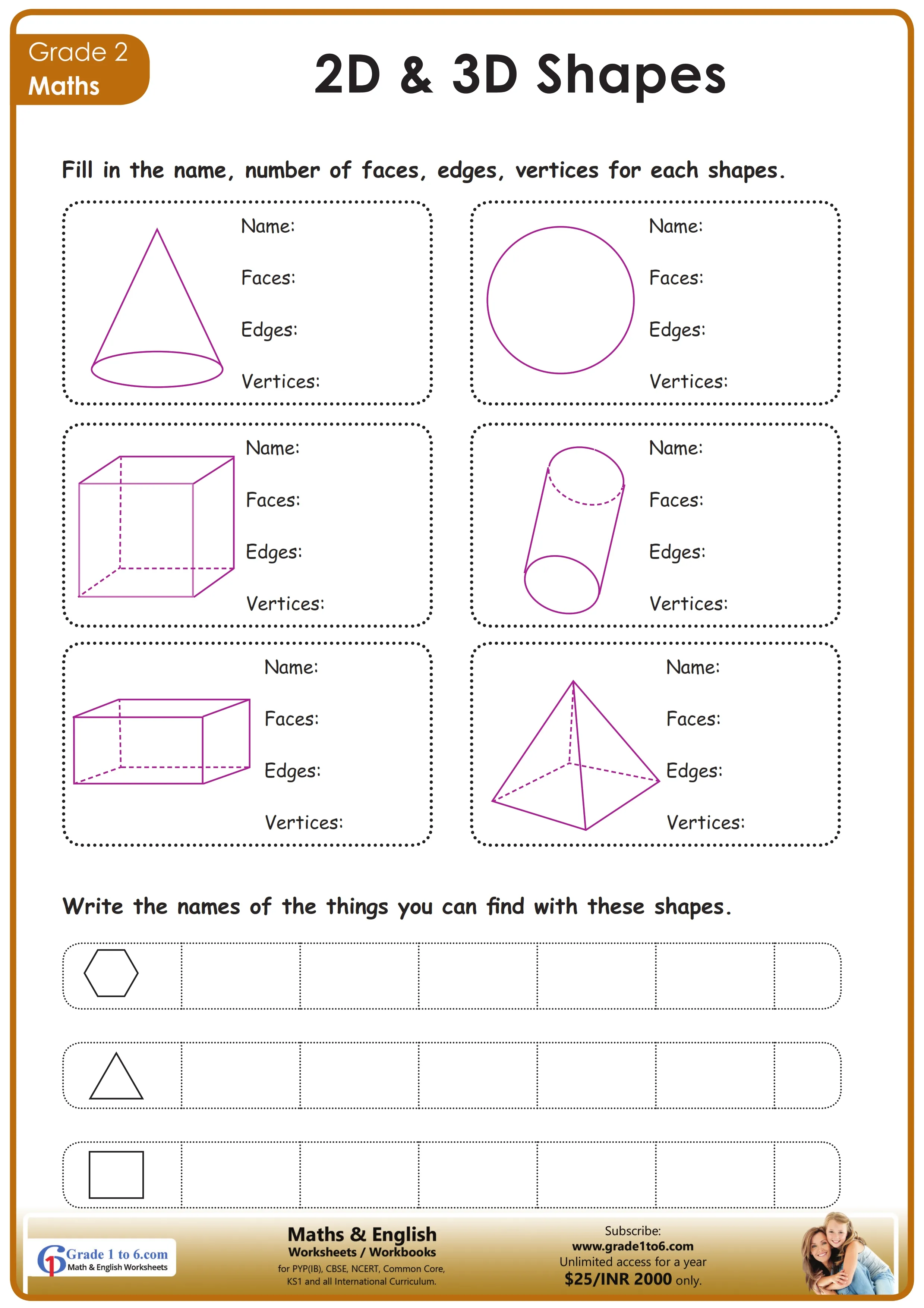
I was chatting with my friend the other day about our kids' school projects, and we got into a deep conversation about understanding 2D and 3D shapes. It's one of those topics that seems simple at first, but the more you think about it, the more fascinating it becomes!
So, what does understanding 2D and 3D shapes really mean? Well, it's all about recognizing and identifying different shapes and forms, and understanding their properties and characteristics. When we say 2D, we're talking about shapes that exist in two dimensions: length and width. Think of a circle, a square, or a triangle on a piece of paper - these are 2D shapes. On the other hand, 3D shapes add an extra dimension: depth or height. So, a sphere, a cube, or a pyramid are examples of 3D shapes.
Seeing the World in Dimensions
Understanding 2D and 3D shapes is not just about geometry or math class; it's a skill that we use in our daily lives, often without even realizing it. When we navigate our way through a room, we're judging distances and angles, which is essentially understanding 3D space. Or when we appreciate a piece of art, we're often drawn to the way the artist uses shape and form to create depth and perspective.
It's also a crucial skill for many professions. Architects and designers, for instance, need a deep understanding of 3D shapes to create functional and aesthetically pleasing spaces. Engineers and scientists use 2D and 3D shapes to model and solve complex problems. Even in fields like fashion and animation, a strong grasp of shape and form is essential.
Making it Practical
So, how can we improve our understanding of 2D and 3D shapes? One fun way is to start noticing and identifying shapes in our surroundings. Look at the architecture of buildings, the design of everyday objects, or even the shapes in nature. You'll start to see circles, squares, and triangles everywhere! You can also try drawing and sketching, which helps train your eye to recognize and reproduce shapes accurately.
For a more structured approach, there are plenty of online resources and tutorials that can guide you through the basics and beyond. Many of these resources use real-world examples and practical applications to make learning fun and engaging.
Final Thoughts
Understanding 2D and 3D shapes is a skill that can enrich our daily lives and open up new perspectives. So, why not give it a go? You might just see the world in a whole new dimension!


